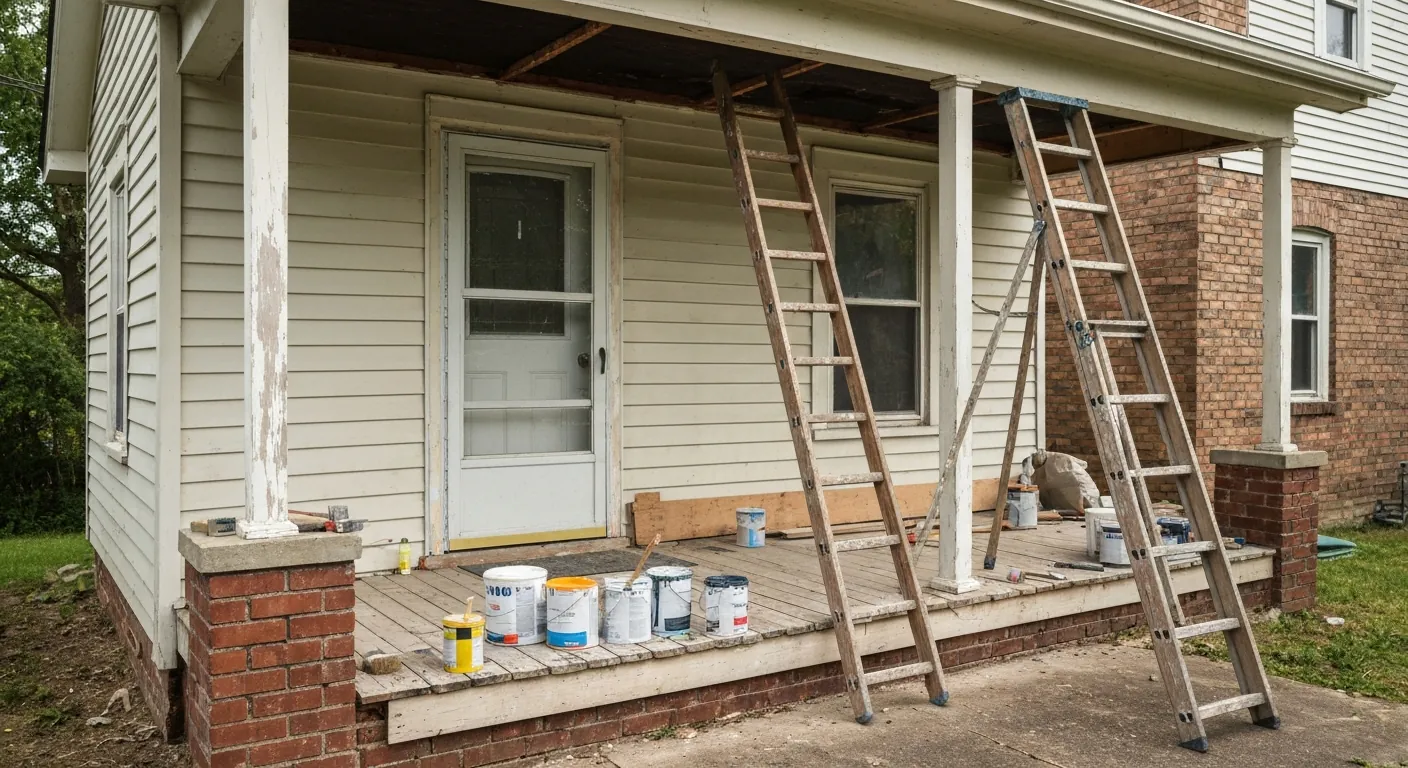
A house mid-renovation with a ladder, paint cans and tools on the porch, no.

Renovation loans · HomeStyle

The Fannie Mae HomeStyle Renovation Loan

The conventional renovation loan — a wider range of allowed work, mortgage insurance that can fall off, more property types, and how it stacks up against an FHA 203(k).

Talk through a renovation loan~10 minutes · soft credit check to start
  • Direct lender — not a call center
  • NMLS #192103
  • Equal Housing Lender
  • Soft credit check to start
Reviewed by Michael Hernandez, Loan Originator · NMLS #192103, on June 17, 2026
5 min readLast updated June 17, 2026Share

Key takeaways

Fannie Mae HomeStyle is a conventional renovation loan that finances a home's purchase (or refinance) plus the cost of improvements in one conforming mortgage, based on the home's as-completed value. Compared with an FHA 203(k), it allows a wider range of work — including luxury items like a pool — covers primary, second, and investment properties, and carries private mortgage insurance that can be canceled once you reach enough equity.

  • It's the conventional option.: HomeStyle is a Fannie Mae conforming loan, so the amount is bounded by the conforming loan limit rather than FHA county limits.
  • Wider range of work.: Almost any permanently affixed improvement qualifies — including luxury features such as a swimming pool that an FHA 203(k) won't fund.
  • Mortgage insurance can fall off.: Like any conventional loan, HomeStyle's PMI can be canceled once you reach enough equity — unlike FHA's longer-lived MIP.
  • More property types.: It can finance primary residences, second homes, and (with conventional terms) certain investment properties.

HomeStyle renovation loan at a glance

HomeStyle renovation loan at a glance
FeatureFannie Mae HomeStyle
Loan typeConventional, conforming (Fannie Mae)
2025 conforming loan limit (one-unit baseline)$806,500
Eligible workAny permanent improvement attached to the home — including luxury items (e.g., a pool)
Renovation budget capUp to 75% of the lesser of (purchase price + reno costs) or the as-completed appraised value
OccupancyPrimary residence, second home, or investment property
Mortgage insurancePrivate mortgage insurance (PMI) — cancellable at sufficient equity

Source: Fannie Mae Selling Guide — HomeStyle Renovation; FHFA 2025 conforming loan limits

What the HomeStyle loan is

HomeStyle Renovation is Fannie Mae's answer to the same problem the FHA 203(k) solves: an ordinary mortgage only lends on a home as it stands today, which doesn't help if the home needs work. HomeStyle is a conventional (conforming) loan that finances the purchase or refinance plus the cost of renovating, sized on the home's as-completed value — what it will appraise for once the work is finished.

Because it's a conforming loan rather than a government-insured one, the maximum is bounded by the annual conforming loan limit ($806,500 for a one-unit home in 2025) rather than by FHA's county-by-county limits, and it follows conventional credit and down-payment guidelines.

The wider range of allowed work

HomeStyle's biggest practical advantage is flexibility. It funds essentially any renovation or repair that is permanently affixed to the property and adds value — and unlike the FHA 203(k), that explicitly includes luxury improvements such as a swimming pool, an outdoor kitchen, or high-end finishes. If your project sits at the higher end of the scope, HomeStyle is usually the program that can actually fund it.

The renovation budget itself is capped relative to value — broadly, the financed work can't exceed 75% of the lesser of the purchase price plus renovation costs or the as-completed appraised value. The mechanics of that limit are covered in how much you can borrow for a renovation.

Mortgage insurance that can come off

Because HomeStyle is conventional, it carries private mortgage insurance (PMI) when your down payment or equity is below the conventional threshold — and the meaningful difference from FHA is that PMI can be canceled once you build enough equity. FHA's mortgage insurance premium (MIP), by contrast, often stays on the loan for far longer.

For a borrower with solid credit who plans to keep the home, that cancellable insurance can make HomeStyle cheaper over time even though FHA may be easier to qualify for up front. Which one nets out better is a real numbers question — the kind a licensed loan officer can run for your specific file.

More property types than the 203(k)

The FHA 203(k) is built for owner-occupants. HomeStyle is broader: it can finance a primary residence, a second home, or an investment property (under conventional terms that tighten as the occupancy moves away from owner-occupied). That makes it the renovation loan to ask about if you're improving a property you won't live in.

As with any renovation loan, the funds are held in escrow and released in draws as the work is inspected and completed, and there are added costs — a contingency reserve, draw inspections — beyond a normal mortgage. See renovation loan costs for the full picture.

HomeStyle vs. the FHA 203(k)

The short version: HomeStyle tends to fit borrowers with stronger credit, a larger or more ambitious project, or a non-owner-occupied property, and it rewards them with cancellable PMI and a wider scope of allowed work. The FHA 203(k) tends to fit owner-occupant buyers who want FHA's flexible credit and low down payment.

Our 203(k) vs. HomeStyle comparison puts the two side by side on every line that matters. When you want it applied to a real property, a soft-credit pre-qualification is the next step.

Frequently asked questions

What is a Fannie Mae HomeStyle renovation loan?

It's a conventional, conforming mortgage that finances both the purchase (or refinance) of a home and the cost of renovating it in one loan, based on the home's as-completed value. It's Fannie Mae's renovation product and the main conventional alternative to the FHA 203(k).

How is HomeStyle different from an FHA 203(k)?

HomeStyle is conventional, so it follows conforming loan limits, allows a wider range of work (including luxury items like a pool), can finance second homes and investment properties, and uses PMI that can be canceled. The FHA 203(k) is government-insured, owner-occupant focused, and carries longer-lived FHA mortgage insurance.

Can a HomeStyle loan pay for a swimming pool?

Yes. Unlike the FHA 203(k), HomeStyle allows luxury improvements such as a swimming pool, as long as the work is permanently affixed to the property and supported by the as-completed appraised value. That wider scope is one of HomeStyle's main advantages.

Can I use HomeStyle on an investment property?

Yes — HomeStyle can finance a primary residence, a second home, or an investment property, with conventional terms (down payment, credit, and reserves) that tighten as you move away from owner-occupancy. That's a key reason it's broader than the owner-occupant-only FHA 203(k).

Does HomeStyle require mortgage insurance?

If your equity or down payment is below the conventional threshold, yes — HomeStyle carries private mortgage insurance (PMI). The advantage over FHA is that conventional PMI can be canceled once you reach enough equity, whereas FHA's mortgage insurance often stays on the loan much longer.

Part of our Renovation Loans guide.

Related guides

Reviewed by Michael Hernandez, Loan Originator · NMLS #192103

Michael Hernandez is a licensed mortgage loan originator with Pacific Bay Lending (Pacific Bay Lending Corp, NMLS #192103), a direct lender serving Tennessee. This guide is general education — not financial advice, a rate offer, or a commitment to lend. Your situation is reviewed individually when you get pre-qualified.

See your real numbers

Get pre-qualified in about 10 minutes — a soft credit check to start, no impact to your score, and no obligation.

Michael Hernandez, Branch Manager · Pacific Bay Lending Corp NMLS #192103 · Equal Housing Lender. Homes shown are public listings for illustration of what's available in this range — not an offer to make a loan on, or sell, a specific property. This is not a commitment to lend; all loans subject to credit approval, program guidelines, and underwriting.

Talk through a renovation loan →