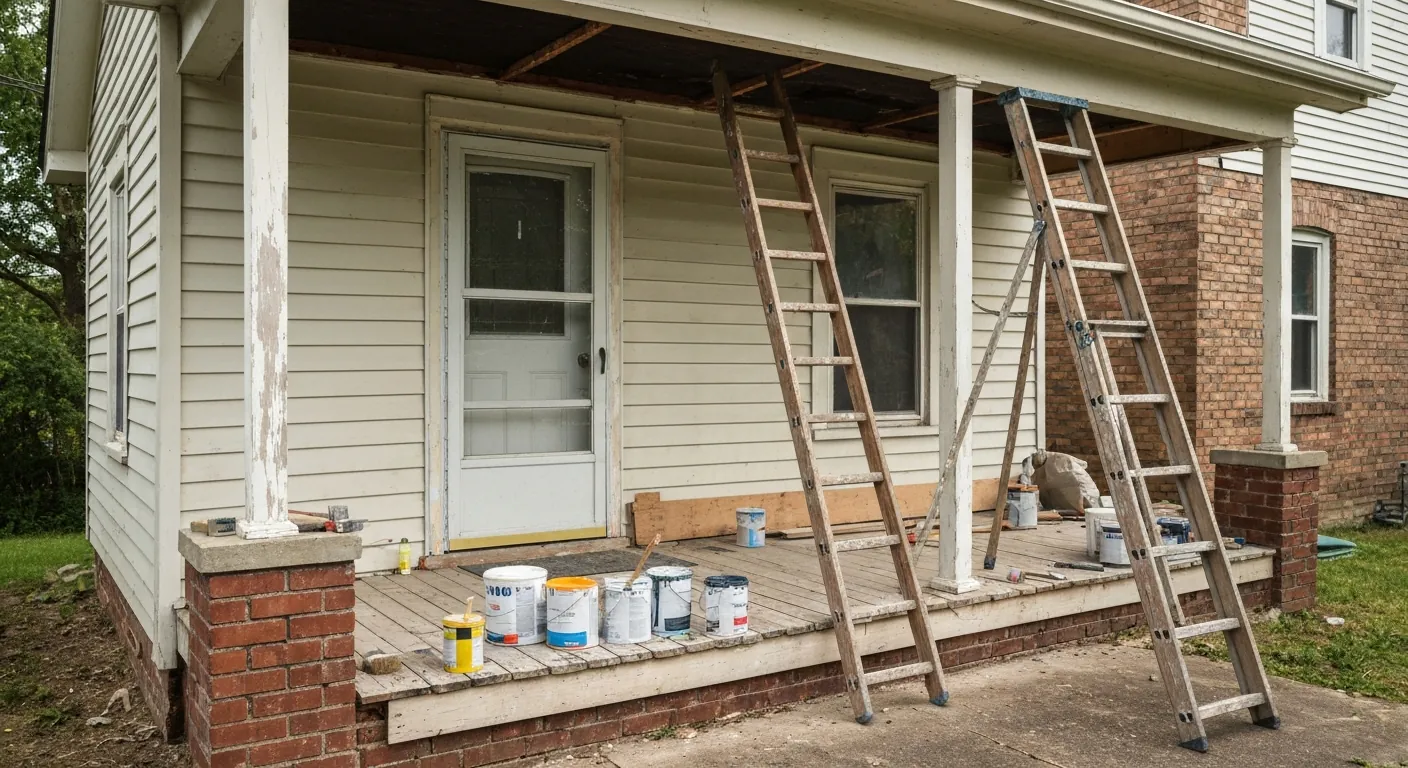
A house mid-renovation with a ladder, paint cans and tools on the porch, no.

Renovation loans · Borrowing limit

How Much Can You Borrow for a Renovation?

The after-improved-value math behind a renovation loan — how the as-completed value sets your limit, the loan-to-value caps by program, and the formula with a worked example.

Talk through a renovation loan~10 minutes · soft credit check to start
  • Direct lender — not a call center
  • NMLS #192103
  • Equal Housing Lender
  • Soft credit check to start
Reviewed by Michael Hernandez, Loan Originator · NMLS #192103, on June 17, 2026
5 min readLast updated June 17, 2026Share

Key takeaways

How much you can borrow on a renovation loan is set by the home's after-improved value — what it will appraise for once the work is done — not its current price. The lender applies a loan-to-value cap to that value: an FHA 203(k) goes up to 96.5%, and Fannie Mae HomeStyle up to 97% for an eligible owner-occupant. Your loan is the lesser of cost-plus-renovation or the value-based cap.

  • After-improved value is the anchor.: The limit is based on what the home will be worth once renovated (the as-completed appraisal), not its as-is price.
  • Two ceilings, lesser wins.: Your loan is the lesser of purchase price plus renovation costs, or the program's value-based cap.
  • LTV caps by program.: FHA 203(k) up to 96.5%; HomeStyle up to 97% for an eligible owner-occupant (lower for second homes and investment properties).
  • Renovation budgets are capped too.: FHA 203(k) limits the loan to 110% of after-improved value; HomeStyle caps renovation funds at 75% of the as-completed value.

How the borrowing limit is set, by program

How the borrowing limit is set, by program
ProgramMaximum loan-to-valueThe loan is the lesser of…
FHA 203(k)96.5% (owner-occupant)(purchase price + renovation + allowable costs), or 110% of the after-improved value
Fannie Mae HomeStyleUp to 97% (eligible owner-occupant; lower for second homes/investment)(purchase price + renovation), or the as-completed appraised value — renovation funds capped at 75% of that value

Source: HUD Handbook 4000.1 (FHA 203(k)); Fannie Mae Selling Guide — HomeStyle Renovation

The number that changes everything: after-improved value

A normal mortgage is sized on what a home is worth today. A renovation loan is different — it's sized on the after-improved value (also called the as-completed value): what the home will appraise for once the planned work is finished. An appraiser reviews the contractor's scope and estimates that future value up front, and that figure becomes the basis for how much you can borrow.

This is the whole reason a renovation loan works. It lets you borrow against value that doesn't exist yet, so you can buy a home that needs work and fund the work without a separate construction loan or a stack of cash.

The formula: the lesser of two ceilings

Every renovation loan amount is the lesser of two numbers, then trimmed by the program's loan-to-value cap:

  • Cost basis — the purchase price (or current payoff) plus the renovation budget and allowable fees.
  • Value ceiling — on an FHA 203(k), 110% of the after-improved value; on HomeStyle, the as-completed appraised value (with renovation funds themselves capped at 75% of it).

Whichever is lower sets the base, and then the LTV cap in the table — 96.5% on a 203(k), up to 97% on HomeStyle for an eligible owner-occupant — determines the loan, with the rest covered by your down payment.

A worked example

Say you buy a Tennessee home for $250,000 that needs $50,000 of work — a realistic mix given that the median list price across our 16,101 active Tennessee listings is $499,000. An appraiser reviews the plans and estimates the after-improved value at $340,000.

  • Cost basis: $250,000 + $50,000 = $300,000.
  • FHA 203(k) value ceiling: 110% × $340,000 = $374,000.
  • The lesser is the $300,000 cost basis.
  • At 96.5% LTV, the maximum loan is about $289,500 — roughly $10,500 (3.5%) down on the project, plus closing costs.

These figures are rounded and illustrative — an estimate to show the mechanics, not a quote. Your actual numbers depend on the appraisal, the program, and your file.

What raises or lowers your limit

Three things move the number most. The after-improved value is the lever — work that adds real, appraisable value raises the ceiling, while over-improving for the neighborhood doesn't. The program matters: an FHA 203(k) is bounded by your county's FHA loan limit, while HomeStyle is bounded by the conforming loan limit. And occupancy changes the LTV cap — owner-occupants get the highest, second homes and investment properties less.

Don't forget the contingency reserve and other renovation costs — they fold into the loan amount too. If you're deciding between programs, the 203(k) vs. HomeStyle comparison covers how the limits differ on a larger project.

Getting your real number

The example above shows the mechanics, but your real limit needs three inputs only a review can supply: the appraiser's after-improved value, the program you qualify for, and your credit and income. A licensed loan officer pulls those together and tells you the actual figure.

A soft-credit pre-qualification is the no-pressure way to start — it won't affect your score, and it turns the formula on this page into a number you can actually shop and budget with.

Frequently asked questions

How is a renovation loan amount calculated?

It's based on the home's after-improved value — what it will appraise for once the work is done. The loan is the lesser of the cost basis (purchase price plus renovation and allowable fees) or the program's value ceiling, then trimmed by the loan-to-value cap (96.5% on an FHA 203(k), up to 97% on HomeStyle for an owner-occupant).

What is after-improved value?

Also called the as-completed value, it's the amount a home is expected to appraise for after the planned renovation is finished. An appraiser estimates it up front from the contractor's scope of work, and it becomes the basis for how much a renovation loan will lend — unlike a normal mortgage, which uses the home's current value.

Can I borrow more than the home is worth today?

In effect, yes — that's the point of a renovation loan. Because the loan is sized on the after-improved value rather than the as-is price, you can borrow against value the renovation will create, within the program's loan-to-value cap and overall loan limit. The work has to support that future value at appraisal.

Does the renovation budget have its own limit?

Yes. On an FHA 203(k) the total loan can't exceed 110% of the after-improved value, and a Limited 203(k) caps repairs at a published amount. On HomeStyle, the renovation funds themselves are capped at 75% of the as-completed appraised value. Those caps are separate from the loan-to-value limit.

How do I find out my exact renovation loan amount?

Your real number depends on the appraiser's after-improved value, the program you qualify for, and your credit and income — so it takes a review. A soft-credit pre-qualification, which doesn't affect your score, lets a licensed loan officer turn the formula into an actual figure you can shop and budget with.

Part of our Renovation Loans guide.

Related guides

Reviewed by Michael Hernandez, Loan Originator · NMLS #192103

Michael Hernandez is a licensed mortgage loan originator with Pacific Bay Lending (Pacific Bay Lending Corp, NMLS #192103), a direct lender serving Tennessee. This guide is general education — not financial advice, a rate offer, or a commitment to lend. Your situation is reviewed individually when you get pre-qualified.

See your real numbers

Get pre-qualified in about 10 minutes — a soft credit check to start, no impact to your score, and no obligation.

Estimate only — not a rate offer, APR disclosure, or commitment to lend. Subject to credit approval and underwriting.

Michael Hernandez, Branch Manager · Pacific Bay Lending Corp NMLS #192103 · Equal Housing Lender. Homes shown are public listings for illustration of what's available in this range — not an offer to make a loan on, or sell, a specific property. This is not a commitment to lend; all loans subject to credit approval, program guidelines, and underwriting.

Talk through a renovation loan →